
Perimenopause and Anxiety: Untangling What’s Hormonal, What’s Situational, and What’s Both
Is This Anxiety, or Is This Perimenopause?
This question comes up constantly in my work, and I want to say clearly upfront: I am not a doctor, and I can’t diagnose either one. But I can help you think through the pattern…
Is This Anxiety, or Is This Perimenopause?”
This question comes up constantly in my work, and I want to say clearly upfront: I’m not a doctor, and I can’t diagnose either one. But I can help you think through the pattern, because the honest answer for most women is: it’s often both, tangled together in a way that’s genuinely hard to separate on your own.
How Hormones Can Drive Anxiety
Estrogen and progesterone don’t just regulate your cycle; they interact directly with neurotransmitters like Serotonin and GABA, chemicals closely tied to mood and calm. As those hormones fluctuate unpredictably during perimenopause, some women experience anxiety that feels like it’s arrived out of nowhere, with no clear external trigger. It can show up as a racing heart at 3 AM, a persistent sense of dread, or irritability that feels disproportionate to whatever set it off. If this sounds new, or noticeably different from how you’ve experienced anxiety in the past, hormonal fluctuation is worth putting on your radar.
How Situational Stress Layers on Top
At the same time, perimenopause often lands in a genuinely demanding season of life: aging parents, kids leaving or not leaving home, career pressure, relationship shifts, and a body that’s simultaneously changing in ways that feel unfamiliar. Real stressors deserve real acknowledgment. It would be inaccurate, and honestly a little dismissive, to wave away every hard emotion during this season as “just hormones”. Your circumstances are allowed to be genuinely difficult, independent of what your hormones are doing.
A Simple Way to Start Untangling It
You don’t need a perfect answer to start getting support, but a few questions can help you and your provider see the pattern more clearly: Does the anxiety track with your cycle, worse in certain weeks and better in others? Does it show up even on days when nothing stressful is happening? Has anything shifted physically alongside it - sleep, hot flashes, cycle changes? Tracking these patterns for a few weeks, even informally in a notes app, gives you something concrete to bring to a medical provider instead of a vague “I’ve just felt off”.
You Don’t Have to Solve This Alone
Whether your anxiety turns out to be mostly hormonal, mostly situational, or genuinely both, the support looks similar at first: nervous system reset tools, a place to be heard without judgment, and help making sense of what you’re experiencing. That’s exactly what Menopause Coaching Support and Breathwork sessions are designed for, alongside, not instead of, the medical care your provider can offer. You don’t have to have this figured out before you reach out. That’s what the Discovery Call is for.
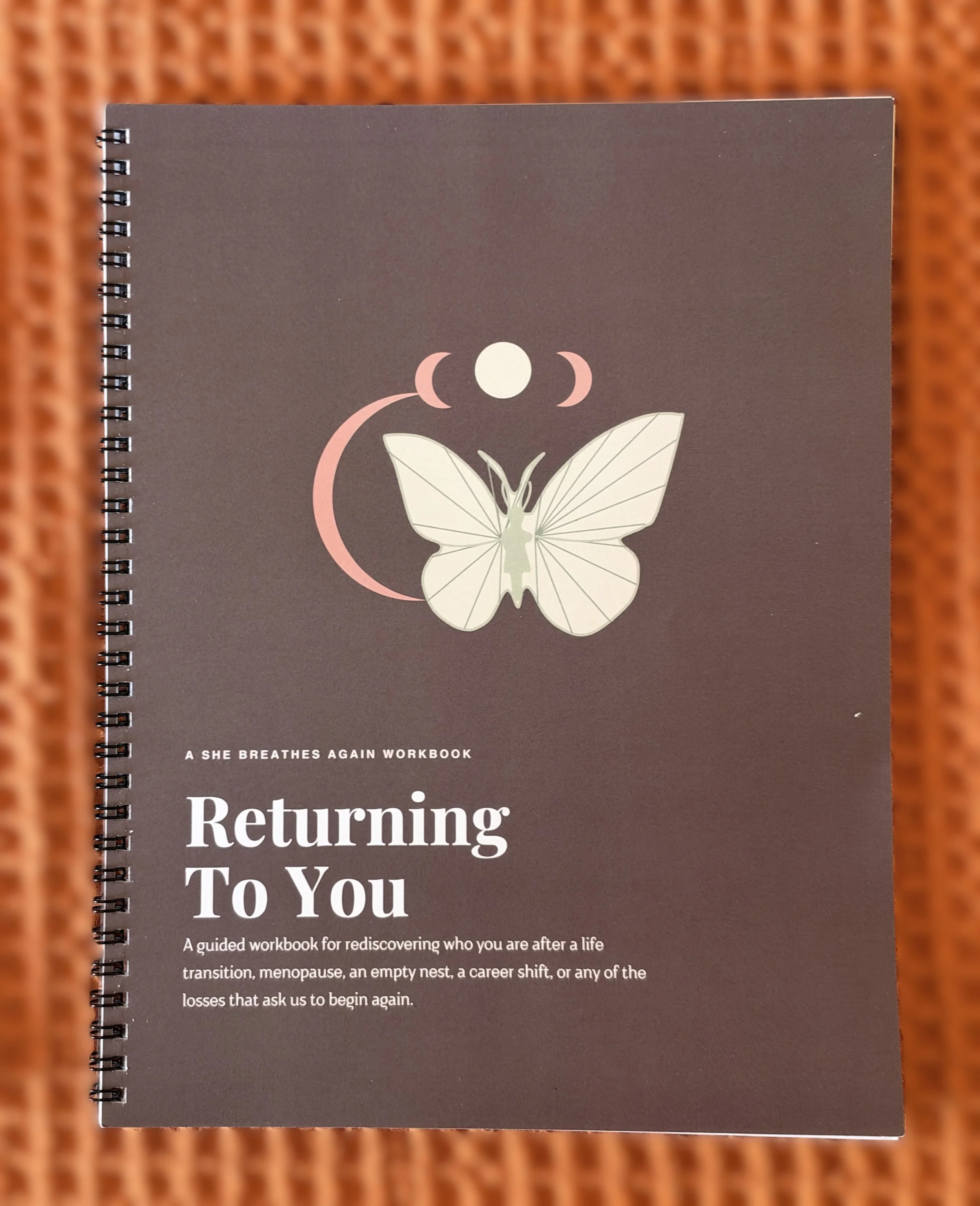
Why I Wrote Returning to You
Understanding Identity after transition
A few years ago, I could have told you exactly who I was. I had a title, a calendar full of other people's needs, and a very efficient way of getting through the day.
Then midlife showed up and rearranged the furniture.
In my early 40s, the brain fog, the mood swings, and the anger I didn't recognize arrived out of nowhere. I was handed a diagnosis that didn't fit and medications that left me feeling even further from myself. It took years to understand that I had been in perimenopause the whole time. What I remember most from that stretch isn't the symptoms. It's the quiet belief that something was fundamentally wrong with me.
Nothing was wrong with me. I had changed, and nobody had given me a way to ask who I was becoming.
The gap I kept noticing
After nearly 30 years in real estate and property management, I moved into menopause coaching and breathwork. Women started sitting across from me, and the same thing kept coming up. It wasn't only hot flashes or poor sleep. It was a quieter question:
Who am I now that my roles have shifted?
The kids moved out. Or the marriage ended. Or the career stopped fitting. Or someone we loved was gone. Or our bodies simply stopped cooperating with the plan. These women weren't looking to be fixed. They wanted room to take inventory of what had changed, to notice which roles still fit and which ones they'd outgrown, and to listen to themselves again without a to-do list attached.
I couldn't find a tool that did that gently, without being therapy and without being another thing to keep up with. So I wrote one.
What it is
Returning to You is a 52-page workbook for women who feel like they've lost the thread of themselves. It contains prompts to help you dig a little deeper when you're ready, and a progress tracker for each section to help you stay present with what you're working toward.
There's no right pace and nothing to get right. Go slowly, skip around, and put it down when you need to.
I wrote it the way I coach: no pressure, no performance, and plenty of permission to take a breath first.
Why "returning"
I chose that word on purpose. I don't believe midlife is about becoming someone new. You aren't broken, and you don't need a makeover. You're remembering and recalibrating, finding your way back to the woman who was there underneath all the roles.
I know that because I'm still doing it myself.
Where to find it
Returning to You is available now as a printed workbook ($40, printed to order, so please allow 10-14 days for delivery). Order Now
And if you'd rather talk it through with a real person, my Discovery Call is free, 20 minutes, and has no pressure attached. Discovery Call
Take a breath. You're in the right place.
Nicole

Why “Just Breathe” Isn’t Advice: The Science Behind Nervous System Reset
“Just breathe” might be the most common, least useful piece of advice ever given to someone who’s overwhelmed.
The Advice Nobody Explains
“Just breathe” might be the most common, least useful piece of advice ever given to someone who’s overwhelmed. It’s not wrong, exactly. It’s incomplete. Breathing on its own doesn’t calm anyone down; you’re already doing that involuntarily whether you’re panicking or perfectly relaxed. What actually changes your state is breathing in a specific, intentional way that sends a particular signal to your nervous system.
Your Nervous System Has Two Modes
Without getting overly clinical, it helps to understand that your automatic nervous system runs in roughly two modes: Sympathetic (activation, alertness, fight-or-flight) and Parasympathetic (rest, digestion, recovery). Both are necessary. The problem for a lot of midlife women isn’t that the sympathetic mode exists: it’s that hormonal shifts, chronic stress, and disrupted sleep can leave the nervous system stuck in activation far more often than it should be, even when there is no actual threat present.
Why Slow, Long Exhales Work
Here’s the mechanism worth knowing: a longer exhale than inhale directly stimulates the Vagus nerve, the primary communication pathway between your brain and your body’s relaxation response. That’s why a pattern like inhaling for four counts and exhaling for six tends to shift your state more reliably than a rushed, shallow breath. It’s not a mindset trick. It’s physiology. Your body is receiving a literal signal that it’s safe to stand down.
This is also why breathing at a slow, steady pace of roughly five to six breaths per minute, sometimes called coherent or resonant breathing, has measurable effects on heart rate variability, a marker researchers use to gauge how well your nervous system can shift between stress and recovery. You’re not imagining that it works. There’s a real biological reason it does.
What This Means For Menopause Symptoms Specifically
For women navigating perimenopause and menopause, this matters even more than usual. Hot flashes, night sweats, and mood swings often trigger a sympathetic nervous system spike, which can then trigger more symptoms, creating a loop. Intentional, slower breathing won’t stop hormonal fluctuations, breathwork isn’t medical treatment and it doesn’t replace care from your physician, but it can interrupt that stress-response loop and help your body recover its footing faster.
Using This Today
Next time someone tells you to “just breathe”, or you feel that instinct yourself, try this instead: four seconds in through your nose, six seconds out through your mouth, for two full minutes. Notice what shifts. That’s the difference between vague advice and an actual tool. If you’d like to build a fuller nervous system reset tool kit that’s tailored to what you’re personally experiencing, that’s the work I do in Breathwork sessions and Mini Breathwork sessions, one steady breath at a time.

Thirty Years in Real Estate Taught Me This About Holding Space
An Unlikely Foundation
People are sometimes surprised to learn that before I became a menopause and breathwork coach, I spent nearly thirty years in real estate and property management.
An Unlikely Foundation
People are sometimes surprised to learn that before I became a menopause and breathwork coach, I spent nearly thirty years in real estate and property management. On the surface, those two careers look nothing alike. One involves leases, budgets, and maintenance calls. The other involves breath, nervous systems, and midlife transitions. The longer I do this work, the more I recognize how directly one prepared me for the other.
What Property Management Actually Teaches You
Property management is, at its core, a job about people in stressful situations. A tenant calling in a panic about a flooded unit, a team member overwhelmed by a deadline, an owner anxious about vacancy numbers. Almost none of that stress was actually about the plumbing or the paperwork. It was about people needing to feel heard, steadied, and guided through something that felt bigger than they could handle alone in that moment.
I spent decades learning how to walk into a chaotic situation and become the calm in the room. Not by having every answer immediately, but by listening first, reflecting back what I heard, and helping someone find their next right step instead of trying to solve everything for them all at once. That is, almost word for word, what I do now in a coaching session or a breathwork practice.
The Skills That Carried Over
Leading teams through high-pressure situations taught me how to read a room and adjust my pace to match what a person actually needed, not what I assumed they needed. Managing complex systems taught me structure: how to build something dependable that people can lean on, whether that’s a maintenance schedule or a coaching container. Handling difficult conversations, again and again, for years, taught me that most people don’t need to be fixed. They need to be witnessed.
Why This Matters for the Women I Work With
Midlife and menopause bring a version of chaos too, just a quieter, more internal kind. Hormones shifting, identity shifting, roles shifting all at once. Many of my clients feel like they’re managing a crisis with no clear playbook, similar to how a tenant feels the night their water heater fails. My job isn’t to hand them a script. It’s to bring some structure, calm, and a steady presence I spent thirty years building, now pointed towards something far more personal than a lease agreement.
I don’t think my path here was a detour from my real work. I think it was thirty years of training for it, just before I had the language to call it that. If you’re in a season where you’re managing more change than you feel equipped for, that’s exactly the kind of steadying support Menopause Coaching Support and Personalized Coaching sessions are built to offer.

Breathwork 101: A Beginner’s Guide To Finding The Right Practice For Your Nervous System
Breathwork Doesn’t Have to Be Intense Work
When people hear “breathwork”, they often picture something intense: crying on a mat, dramatic emotional release, maybe even a little frightening.